This article is provided for informational and educational purposes only and does not constitute investment advice, financial advice, or a recommendation to buy or sell any asset.
Regulatory clarity is often framed as a growth catalyst for crypto markets. When rules become clearer, the assumption is that capital naturally follows.
In practice, regulation plays a far more selective role. It removes friction from the system, but it does not decide outcomes. Once regulatory uncertainty disappears, infrastructure determines who captures capital.
A stablecoin without productive utility is idle capital. In a post-regulation environment, idle capital is no longer neutral. It carries opportunity cost and quickly becomes a liability.
When the GENIUS Act passed in July 2025, the market reaction appeared reassuring at first glance. Volatility compressed, and stablecoin-related assets demonstrated relative resilience compared to the broader crypto market. Many interpreted this as evidence that regulation had “validated” stablecoins as a category.
But regulation did not create value. It exposed which systems were already engineered to absorb capital once friction was removed. The most meaningful shift did not appear in headlines or short-term price movements. It unfolded on-chain.
Regulatory Clarity Is Not a Growth Strategy
Regulation does not generate yield, bootstrap liquidity, or design markets. What it does is filter the ecosystem.
Before the GENIUS Act, institutional capital faced structural uncertainty around reserve requirements, governance expectations, and compliance exposure. After the act passed, that ceiling lifted. However, capital did not flow evenly across the stablecoin landscape. Instead, it concentrated around protocols with infrastructure capable of deploying stable assets productively, transparently, and at scale.
This distinction matters. Price stability alone does not indicate adoption. It often reflects caution rather than conviction. Capital commits where it can work, not where it can merely sit safely.
What the Data Revealed After GENIUS
Once regulatory uncertainty receded, several structural patterns began to emerge in the data.
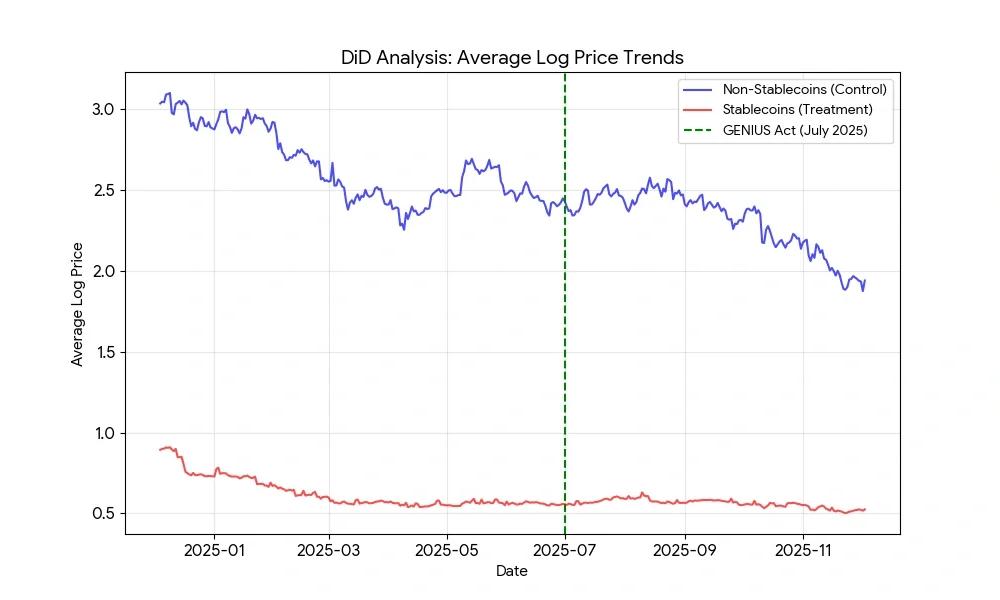
Difference-in-Differences analysis: stablecoin-related assets vs broader crypto market
Post-GENIUS market behavior showed a statistically significant divergence between stablecoin-related assets and the broader crypto market. This was not a generalized uplift driven by sentiment. It was a selective response.
More importantly, the divergence was not explained by price stability alone. On-chain activity revealed a deeper shift in how capital was deployed. TVL growth increasingly concentrated in lending and money-market primitives rather than passive stablecoin balances. Utilization rates became stronger indicators of adoption than total supply. Yield-bearing stablecoin designs consistently retained capital longer than non-productive alternatives.
Stablecoins did not benefit by default. Productive stablecoins did.
Why Stablecoins Without Yield Remain Idle Capital
A dollar that does not generate return is not neutral. It carries opportunity cost.
After GENIUS, that cost became explicit. With regulatory risk reduced, the market began pricing capital efficiency far more aggressively. Stablecoins held without productive pathways quickly became less attractive than systems offering predictable yield, transparent risk parameters, and composable deployment options.
This shift drove demand for ecosystems capable of supporting regulated-friendly lending markets, yield-bearing stablecoin architectures, transparent money-market primitives, and treasury systems designed for institutional flows. Regulation removed the blocker, but infrastructure determined the destination.
Price Stability Does Not Equal Adoption
Price is a lagging indicator. Stable prices can mask stagnation just as easily as growth. True adoption reveals itself elsewhere: in sustained TVL growth, capital velocity across protocol primitives, repeated reuse of deposited assets, and resilience under load.
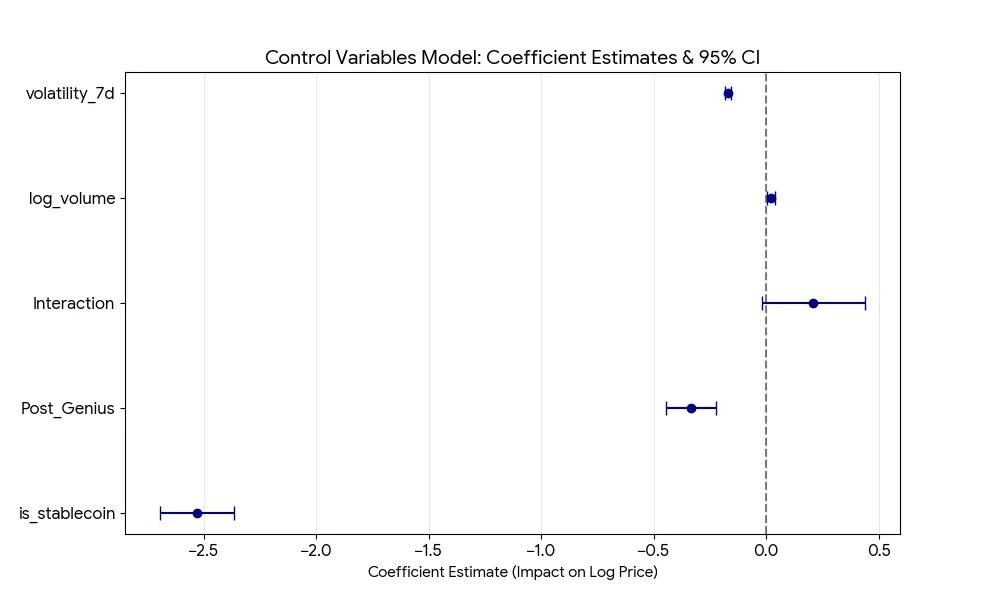
Controlled impact analysis with volatility and liquidity controls
Even after accounting for volatility and liquidity differences, stablecoin-related assets retained a positive post-GENIUS effect. This reinforces that the observed shift was structural rather than incidental.
In the months following regulatory clarity, many projects highlighted relative price insulation while on-chain activity remained flat. Others experienced compounding inflows because they offered clear, secure pathways for capital deployment. The difference was not compliance. It was infrastructure readiness.
The Infrastructure Behind Productive Stablecoins
Productive stablecoin ecosystems are not assembled incrementally. They are architected.
They require audited and battle-tested smart contracts, deterministic yield logic, modular composability with DeFi primitives, governance aligned with capital providers, and treasury systems engineered for scale and transparency. These are not features layered on top of a token. They are financial engines.
Once regulatory friction disappears, markets stop rewarding intention and start rewarding execution.
Why “Just Launching a Stablecoin” No Longer Works
GENIUS clarified what qualifies as a compliant dollar-pegged asset. It did not guarantee demand.
A stablecoin without integrated yield mechanics, lending or liquidity markets, a treasury strategy, and composable DeFi hooks remains parked capital. Institutions do not deploy capital to park it. They deploy it to work, under conditions that preserve trust, predictability, and security.
This is why post-regulation growth favored systems designed from the outset for capital productivity rather than narrative alignment.
Protofire Perspective: Growth Is Engineered
Across L1s, L2s, and DeFi protocols, a consistent pattern emerges. Regulatory clarity opens opportunity windows. Infrastructure determines who captures them.
Token utility does not emerge from compliance alone. It is created through staking systems that retain liquidity, liquid staking architectures that unlock capital efficiency, DEXs designed for depth rather than surface-level volume, lending markets built for sustained utilization, and treasury systems capable of supporting institutional flows.
Together, these components form the economic engine of an ecosystem. Like any high-stakes financial system, they must be built with rigor, security, and scalability at their core.
Regulation Opens the Door. Infrastructure Decides Who Wins
GENIUS did not save stablecoins. It raised the bar for everyone.
The next phase of ecosystem growth will not be driven by regulatory headlines. It will be driven by infrastructure capable of transforming stable assets into productive capital at scale.
Regulation removed friction. Infrastructure determines outcomes.
At this stage of the market, growth is engineered.