























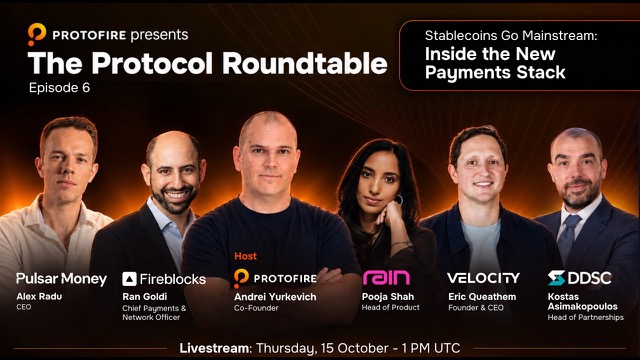
Why banks and remittance firms stay on stablecoins once they start
 Ran Goldi, Fireblocks
Moment at 58:06Episode 6 · Stablecoins Go Mainstream: Inside the New Payments Stack
Blockchain infrastructure for payment providers is the on-chain layer a regulated PSP, bank, or cross-border platform uses to settle payments with stablecoins under its own brand: stablecoin settlement, on/off-ramp orchestration, treasury and reconciliation, and 24/7 operations, wired into its existing product and license.

Reviewed by Luis Medeiros, Field CTO at ProtofireLast reviewed: October 2026
Payment providers, banks, and cross-border platforms are watching settlement volume shift to stablecoin rails, and the ones that do not offer it lose the route to a competitor that does. Blockchain infrastructure for payment providers is the on-chain layer that lets a regulated provider settle payments with stablecoins instead of correspondent banks, inside its existing product and under its own license: on-ramp and off-ramp orchestration, a stablecoin issuer mix, cross-chain settlement, treasury and reconciliation into the core ledger, compliance hooks, and the 24/7 operations to run it.
Protofire builds and operates that layer. We are an engineering-led firm with 250+ projects shipped since 2016 and a core contributor to the primitives it depends on, so a provider can offer faster, cheaper settlement without standing up a web3 engineering organization first.
The provider keeps its license, its core systems, and its customers; these seven layers wire stablecoin settlement into what it already runs.
We build for regulated providers that move money and want stablecoin rails inside their own product. A payment service provider offering stablecoin settlement to its merchants and keeping the spread. A bank or digital bank adding stablecoin rails to its cross-border product under its own license.
A remittance or trade-finance platform whose importer and exporter customers already ask for stablecoin settlement. And a fintech that wants cross-border settlement inside its app without building a crypto engineering team. The common precondition, which we qualify on before building, is a regulated provider of record that owns the compliance perimeter, real volume on defined routes, and a core system we can reconcile against.
Correspondent banking moves an international payment through a chain of intermediary banks, each taking a fee and adding a delay, with money pre-funded in nostro accounts that sits idle in every destination currency. The World Bank puts the global average cost of sending a cross-border remittance at over 6 percent (source: World Bank Remittance Prices Worldwide), most of it in those intermediary hops.
Meanwhile the provider's own customers, importers, exporters, and trade businesses, increasingly settle in stablecoins, and they would rather do it inside a regulated provider they know than through a global app that does not know their market. Offering stablecoin settlement, though, means multi-issuer and multi-ramp integration, treasury and FX flows, reconciliation into an existing core, regulatory reporting, and 24/7 operations, the engineering the global infrastructure vendors will not prioritize for anyone but the largest platforms, and that a payment provider's own team cannot hire for at market speed. Every quarter of delay is route share handed to whoever integrates first.
We build the full stablecoin payment layer and operate it if wanted. The core is stablecoin cross-border payment infrastructure: issuer and ramp orchestration, treasury and reconciliation, and cross-chain settlement, under your brand.
For an e-money institution whose customers hold euros in their own wallets, we build wallet-linked IBAN accounts: signed address binding, mint and burn orchestration and reconciliation against the token supply. Around it we bring the primitives a payment product runs on: Chainlink CCIP integration for cross-chain settlement, oracle integration for price and FX reference data, and Proof of Reserve where a stablecoin's backing has to be attested on-chain.
Where a provider wants its own dollar rather than a third-party coin, we build native stablecoin issuance and the broader tokenization infrastructure for regulated on-chain products. And once a product is live, managed on-chain operations keeps it watched and maintained 24/7.
You stay the licensed provider of record throughout; we are the engineering and operations partner, not a money transmitter, issuer, or custodian.
Our blueprint library documents payment architectures already running at regulated institutions: the regime that permits each one, named institutions operating it, and which layers a provider owns, rents, or has us build. Six are drawn for payment and e-money institutions:
Pay beneficiaries in stablecoins across corridors you already serve, from a funded float to an on-chain or local off-ramp payout.
Accept crypto and stablecoins at the till and settle merchants in euro with no crypto exposure, on the terminals they already have.
Bind an account number to an address the customer holds the keys to, so an ordinary SEPA transfer arrives on chain.
Issue a euro e-money token in your own name under MiCA, with the reserve, monitoring and disclosure operation behind it.
Make minting fail closed, with divided, rate-limited authority and supply reconciled against safeguarded reserves.
Put a euro stablecoin in your product on a licensed issuer's rails, with no issuance licence of your own.
Protofire is an engineering-led blockchain development firm with 250+ projects shipped since 2016, across 60+ networks and 95+ protocols. The credentials that matter for a payment product are specific. We are a core contributor to Chainlink, including CCIP, the cross-chain messaging standard that moves value between networks, and the oracle layer for price and FX reference data.
We deployed Safe, the custody-governance layer that guards treasury keys, on 120+ EVM networks, where it secures $2B+. We build the subgraphs that make every settlement queryable for reconciliation and reporting, and from 2020 to 2024 we ran a top-3 indexer on The Graph by indexing rewards.
And we built the DEX core and subgraph for Swarm Markets, a BaFin-licensed DEX at launch where only KYC-verified wallets can trade, so we know the discipline a regulated payment product needs. The cross-chain, custody, indexing, and compliance layers a payment product is built on are ones we help maintain.
“The provider keeps its license, its customers, and its pricing; we build the rails, the treasury and reconciliation flows, and the operations that turn stablecoin settlement into a production payment product.”
We built the DEX core and subgraph for Swarm Markets, a BaFin-licensed DEX at launch where only KYC-verified wallets can trade tokenized real-world assets, the regulated discipline a payment product needs to go live and scale.
Ran Goldi, Fireblocks
Moment at 58:06Episode 6 · Stablecoins Go Mainstream: Inside the New Payments Stack
Tell us what you are building. An engineer reads it, we have a short call, and the written proposal follows within one business day.
Budget
An NDA is available from the first message and can cover anything you share. How it works