





















What enterprises ask before they commit to a chain
 Gagan Mac, Circle
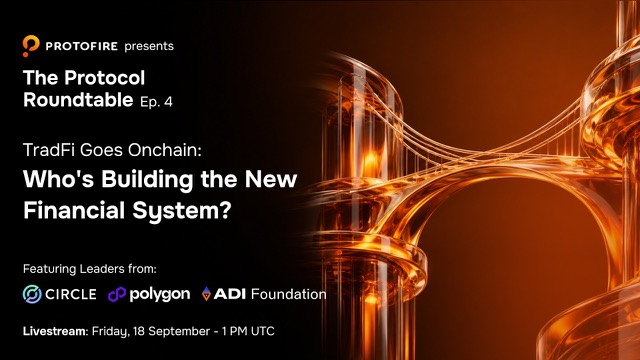
Moment at 45:48Episode 4 · TradFi Goes Onchain: Who's Building the New Financial System?
Enterprise blockchain is about getting compliance, custody, and audit trail right. We build institutional blockchain systems, permissioned ERC-3643 tokens, on-chain compliance, and institutional custody on public and permissioned networks, with real regulated delivery behind us: the DEX core for Swarm Markets, a BaFin-licensed DEX at launch, and a UNICEF and ITU deployment (Giga).

Reviewed by Renat Khasanshyn, Chief Executive Officer at ProtofireLast reviewed: October 2026
Enterprise blockchain is not the same problem as a consumer dApp. A bank, an asset manager, or a public institution needs the compliance, custody, and audit trail regulators and boards require, on a network their counterparties will actually use. The engineering is in getting identity, permissions, controls, and reporting right, so that value only moves between eligible parties and every action is provable after the fact.
Protofire has shipped 250+ blockchain projects since 2016, and the regulated end of that record is real, not aspirational. We built the DEX core and subgraph for Swarm Markets, a BaFin-licensed decentralized exchange at launch where only KYC-verified wallets can trade tokenized securities.
We built the on-chain monitoring for Giga, a UNICEF and ITU initiative connecting schools across countries, a government-grade deployment measured in tens of thousands of sites. We build on the permissioned Polymesh security-token chain, and we engineer institutional credit systems on Aave.
We maintain Solhint, the Solidity linter used by 1M+ developers, so the contracts an institution relies on hold to the standard the ecosystem checks against.
We build the enterprise system you need: permissioned ERC-3643 tokens, compliance enforced in code, institutional custody and governance, and the assurance and operations around them, on the public or permissioned network your use case requires. Take the full build or the specific layer that is blocking your compliance sign-off.
Enterprise systems live or die on the layers around the token: who is eligible, who can approve, and what can be proven later.
Most enterprise use cases need a token only eligible parties can hold. We build permissioned tokens on ERC-3643 (the T-REX standard), with on-chain identity through ONCHAINID, whitelists, and transfer rules that enforce eligibility in the contract itself.
Our regulated-venue experience is first-hand: we built the DEX core and subgraph for Swarm Markets, a BaFin-licensed DEX at launch where only KYC-verified participants can trade, working underneath Swarm's own permissioning layer. The permission logic has to be correct and hardened before it reaches an audit. Benefits: eligibility enforced in code, not policy, on-chain identity and transfer rules, built for a venue that launched under BaFin licenses.
We wire KYC, AML, transaction screening (KYT), sanctions, and Travel Rule checks into the product and enforce them on-chain, integrating the screening providers you already use. Our compliance work is grounded in regulated venues: we built the DEX core and subgraph for a KYC-gated venue that launched under BaFin licenses, and we design for regimes like MiCA rather than retrofitting them.
The goal is a system where an ineligible transaction is blocked at the contract level. Benefits: KYC, AML, and sanctions enforced on-chain, screening providers of your choice, designed for MiCA and BaFin-grade scrutiny.
An institution cannot hold assets behind a single private key. We deploy and customize Safe smart-account infrastructure for multisig control, and we integrate Fireblocks or an MPC custodian for institutional key management, without ever holding your funds.
On top of that we build the governance an organization needs: policy and approval matrices, scoped permissions, and treasury controls, so who can approve what is defined and provable. We deployed Safe on 120+ EVM networks, where it secures $2B+. Benefits: multisig and MPC custody, policy and approval matrices, treasury controls sized for an institution.
Enterprise blockchain does not mean one architecture. We build on public EVM networks when composability and liquidity matter, and on permissioned, regulated chains such as Polymesh when the use case demands built-in identity and securities rules. Our public work includes the Polymesh explorer built on the Polymesh SDK.
We choose the network your compliance and counterparties require, rather than defaulting you onto an architecture that strands you or that we cannot support in production. Benefits: public or permissioned, chosen for your compliance, not our convenience, real experience on regulated chains.
Regulators, auditors, and boards need to verify what happened. We build Proof of Reserve attestation for backed assets, the oracle and indexing layers that make on-chain state queryable and auditable, and 24/7 managed operations under SLA.
We built the on-chain monitoring for Giga, a UNICEF and ITU initiative tracking school connectivity across tens of thousands of sites, so operating a system at institutional scale is something we have done, not just designed. Benefits: Proof of Reserve and audit trail, monitoring and indexing for oversight, 24/7 operations under SLA.
Protofire is a blockchain development company with 250+ projects across 60+ networks and 95+ protocols since 2016, and the regulated, institutional end of that work is first-hand. We built the DEX core and subgraph for Swarm Markets, a BaFin-licensed DEX at launch where only KYC-verified wallets can trade tokenized securities.
We built the on-chain monitoring for Giga, a UNICEF and ITU initiative connecting schools across countries. We build on the permissioned Polymesh security-token chain, and we engineer institutional credit systems on Aave.
We build permissioned tokens and on-chain compliance, we deployed Safe on 120+ EVM networks, where it secures $2B+, and we integrate Fireblocks and MPC custodians for institutional key management. We maintain Solhint, the linter used by 1M+ developers, so the contracts an institution relies on hold to the standard the ecosystem sets.
“Only eligible parties can hold the asset, only authorized signers can approve, and every action is provable after the fact.”
The Protofire repositories behind this page
| Dimension | Public EVM | Permissioned (e.g. Polymesh) |
|---|---|---|
| Access control | At the token and identity layer (ERC-3643) | Built into the protocol |
| Liquidity and composability | Deep | Limited to the network |
| Compliance | Enforced in the contracts | Enforced at protocol and contract level |
| Best for | Regulated products needing liquidity and tooling | Securities use cases needing native identity rules |
Gagan Mac, Circle
Moment at 45:48Episode 4 · TradFi Goes Onchain: Who's Building the New Financial System?
Tell us what you are building. An engineer reads it, we have a short call, and the written proposal follows within one business day.
Budget
An NDA is available from the first message and can cover anything you share. How it works