























Why stablecoins fix settlement latency before price
 Brian Butler, Polygon Labs
Moment at 07:05Episode 4 · TradFi Goes Onchain: Who's Building the New Financial System?
Stablecoin cross-border payment infrastructure is the system a regulated provider needs to settle international payments on stablecoin rails instead of correspondent banks: issuer and on/off-ramp orchestration, treasury and reconciliation, and cross-chain settlement, built into its own product and under its own license.

Reviewed by Luis Medeiros, Field CTO at ProtofireLast reviewed: October 2026
Cross-border payments still move on correspondent banking: a chain of intermediary banks, pre-funded nostro accounts, cut-off times, and settlement that lands days later after several fees and an FX spread. The World Bank puts the global average cost of sending a cross-border remittance at over 6 percent (source: World Bank Remittance Prices Worldwide), most of it in those intermediary hops.
Stablecoin cross-border payments replace that chain with a dollar or euro-pegged token that settles on public blockchain rails in minutes, any day, without pre-funding an account in every destination. Stablecoin cross-border payment infrastructure is the full system a regulated provider needs to offer that inside its own product: the stablecoin issuer and on/off-ramp integrations, the treasury and reconciliation flows, the cross-chain settlement layer, the compliance hooks, and the operations to run it.
Protofire builds and operates that layer. We are an engineering-led firm with 250+ projects shipped since 2016 and a core contributor to the primitives it depends on, Chainlink (CCIP and oracles), Safe (custody), and The Graph (indexing). We are a vendor-neutral integrator: we assemble the best issuer, ramp, and chain mix for your product rather than locking you to one provider, and you stay the licensed provider of record.
A production cross-border payment product needs seven coordinated layers; we build, and if wanted operate, each one inside your existing product.
The value is not the blockchain, it is everything a regulated provider needs around it, the part global infrastructure vendors do not prioritize for anyone but the largest platforms. We integrate stablecoins such as USDC and USDT, where each corridor's rules allow them, so the product is not tied to a single coin, and we integrate on-ramps and off-ramps per route so funds enter and leave in local currency.
We build vendor-neutral, assembling the best issuer and ramp combination for each route rather than locking you to one provider's coverage map, and keeping the option to change it as coverage evolves. Benefits: not locked to one stablecoin or ramp · best issuer and ramp mix per route · your brand in front, our engineering behind.
We build the treasury and FX flows that manage float, rebalancing, and exposure, and the reconciliation that maps every on-chain settlement back to your core banking or ledger system so the books close cleanly. Treasury keys sit behind Safe multisig with a defined authority matrix rather than a single signer, and settlement data is indexed through The Graph so it is queryable for reporting and audit.
Three of our blueprints document versions of this already running at regulated firms: stablecoin payout corridors for a payment provider, stablecoin payments raised from a corporate TMS, and wallet-linked IBAN accounts, where an ordinary SEPA transfer arrives on chain. The last two are services of their own: stablecoin payments from a treasury system and wallet-linked IBAN accounts. Benefits: on-chain settlement reconciled to your core ledger · Safe multisig treasury custody with an authority matrix · queryable, auditable settlement data.
When value has to move between networks, we add cross-chain settlement with Chainlink CCIP, the standard we help maintain as a core contributor, rather than a custom bridge you carry the risk of for the life of the product. When the value moving is USDC specifically, we integrate Circle's Cross-Chain Transfer Protocol (CCTP), which moves native USDC between chains by burning it on the source and minting it on the destination instead of wrapping it, so there is one canonical USDC everywhere and no wrapped-asset or bridge-custody risk.
Manipulation-resistant price and FX references come from the Chainlink oracle layer, and reserve attestation, where a stablecoin's backing must be proven on-chain, from Chainlink Proof of Reserve. Benefits: cross-chain settlement without custom bridge risk · manipulation-resistant FX and price references · reserve attestation on-chain, not in a monthly PDF.
We build KYC, AML, and travel-rule hooks into your existing compliance stack rather than replacing it, inside your regulatory perimeter. And because live money is never unattended, the same team can run monitoring, incident response, and lifecycle operations after go-live. Rail choice and program design follow your regulatory reality, not the other way around. Benefits: compliance hooks inside your perimeter, not a replacement · 24/7 operations available after launch · you stay the licensed provider of record.
Stablecoin cross-border payment infrastructure is the software that lets a regulated payment provider settle international payments using stablecoins instead of correspondent banks. A sender's local currency is converted to a stablecoin at an on-ramp, the stablecoin moves across a blockchain to the destination, and it is converted back to local currency at an off-ramp, or held as a digital dollar.
Around that simple path sits the real engineering: orchestration that picks the right issuer and ramp per route, a treasury system that manages float and FX exposure, reconciliation against the provider's core ledger, cross-chain messaging when value has to move between networks, and monitoring and incident response for money that is live 24/7. It is the difference between a demo that sends one test transfer and a production payment rail an auditor and a regulator will accept, and the provider keeps its license, its customers, and its pricing throughout.
The field spans stablecoin issuers such as Circle (USDC) and Tether (USDT), payment-rail and orchestration providers such as Bridge (part of Stripe since February 2025), BVNK (part of Mastercard since August 2026) and zerohash, and settlement networks such as Circle Payments Network and Ripple. Protofire runs none of these rails: we build the vendor-neutral integration layer that assembles the right ones per route into one product a regulated provider owns.
We are the engineering and operations partner, not a financial institution. The client remains the licensed provider of record: its customers, its compliance perimeter, its pricing, its regulatory reporting. We are not a money transmitter, a stablecoin issuer, an exchange, or a custodian, and we do not hold client or customer funds.
Rail choice, program design, and which routes and counterparties are in scope follow the client's regulatory reality and its counsel's perimeter. Treasury custody runs through Safe multisig under an authority matrix the client controls. This separation is deliberate: it keeps the provider in control of everything a regulator cares about, while we own the part that is genuinely engineering.
Protofire is an engineering-led blockchain development firm with 250+ projects shipped since 2016, across 60+ networks and 95+ protocols. The credentials that matter for cross-border settlement are specific. We are a core contributor to Chainlink, including CCIP, the cross-chain messaging standard that moves value between networks, and the oracle layer for manipulation-resistant price and FX references.
We deployed Safe, the custody-governance layer that guards treasury keys, on 120+ EVM networks, where it secures $2B+. We build subgraphs on The Graph, the layer that makes every settlement queryable for reconciliation, and from 2020 to 2024 we ran one of its top three indexers by indexing rewards.
We maintain Solhint, the Solidity linter used by 1M+ developers, and harden every contract before an external auditor sees it. We also built the DEX core and subgraph for Swarm Markets, a BaFin-licensed DEX at launch where only KYC-verified wallets can trade.
The cross-chain, custody, and indexing primitives this infrastructure is built on are tools we help maintain.
“The provider keeps its license, its customers, and its pricing; we build the rails, the treasury and reconciliation, and the operations that turn stablecoin settlement into a production payment product.”
We built the DEX core and subgraph for Swarm Markets, a BaFin-licensed DEX at launch for tokenized real-world assets where only KYC-verified wallets can trade, while Swarm runs its own permissioning: the same licensed-operator, engineering-underneath split a regulated payment product needs.
| Correspondent banking | Stablecoin rails with Protofire | |
|---|---|---|
| Settlement time | Days, subject to cut-offs and time zones | Minutes on-chain, any day; the local-currency payout follows the destination bank rail |
| Working capital | Pre-funded nostro float in each currency | One stablecoin float in place of cash parked in each corridor |
| Intermediaries | A chain of correspondent banks, each a fee | Peer-to-peer settlement on public rails |
| Product control | Rails dictate the product and pricing | Your brand, your pricing, your route mix |
| Reconciliation | Statements across multiple banks | On-chain, queryable, mapped to your core |
| After go-live | Banking-relationship overhead | Operated as a service, monitoring and response |
Brian Butler, Polygon Labs
Moment at 07:05Episode 4 · TradFi Goes Onchain: Who's Building the New Financial System?
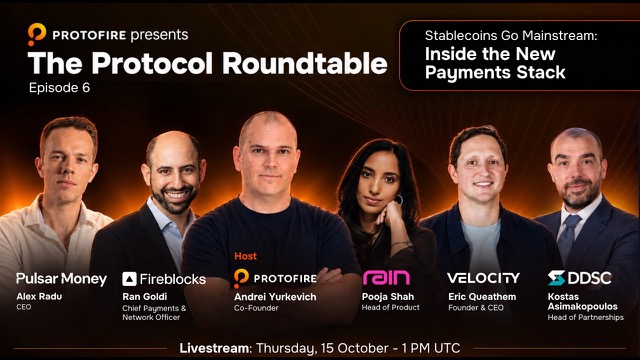
 Ran Goldi, Fireblocks
Moment at 58:06Episode 6 · Stablecoins Go Mainstream: Inside the New Payments Stack
Tell us what you are building. An engineer reads it, we have a short call, and the written proposal follows within one business day.
Budget
An NDA is available from the first message and can cover anything you share. How it works